
Accession number
MS M.1249
Object title
Emblem Book of Antoine du Bourg.
Created
France, Paris, ca. 1535-1538
Binding
Eighteenth-century mottled calf, flat spine gilt and lettered EMBLEM DE DU PRAT MANU SCRIT, red edges. Upper joint broken, old repairs to joints and ends of spine.
Credit line
Purchased on the T. Kimball Brooker Foundation Book Purchase Fund in honor of the Morgan's Centennial, 2024.
Description
50 leaves, bound : paper, ill. ; 204 x 148 mm (177 x 108 mm)
Provenance
Antoine du Bourg (ca. 1490-1538); François Didier Petit de Meurville (1793-1873), of Lyon; sold in Paris, Palais Royale, March 1843, lot 361; bought by Jean-Baptiste Barrois (1785-1855); purchased by Bertram, 4th Earl of Ashburnham (1797-1878), in 1849, his Barrois MS CCCC (with his green paper label on spine); Bertram, 5th Earl of Ashburnham (1840-1913); sold in London, Sotheby's, 10-14 June 1901, lot 493; Joseph Baer & Co., Frankfurt, Catalogue 500 (1908), item 29; sold by Hamill & Barker, Chicago, in 1978; bought by Arthur and Charlotte Vershbow; their sale, New York, Christie's, 9 April 2013, lot 32; bought by T. Kimball Brooker; his sale, London, Sotheby's, 9 July 2024, lot 509.
Notes
An early illustrated emblem book, written shortly after the first publication of Alciati in 1531.
50 leaves (the last 3 blank), 20-22 lines in brown ink, ruled in red; collation: i + 53 + i leaves
Original foliation in ink 1-20 omitting leaf after fol.12, later foliation in pencil 21-51 correcting earlier omitted leaf, occasional remains of earlier foliation in lower left margin of rectos.
Nineteen miniatures, each headed by a motto in liquid gold on a red scroll.
The motto on fol. 44v is a pasted replacement.
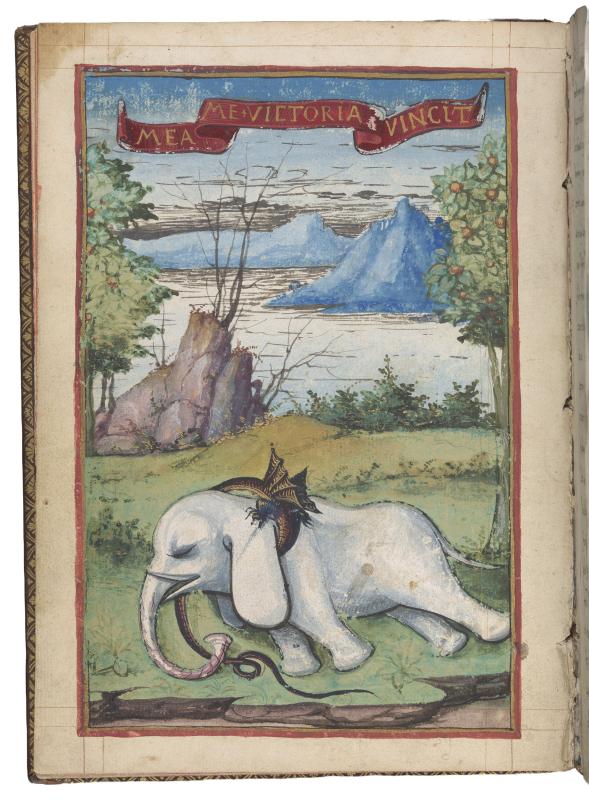
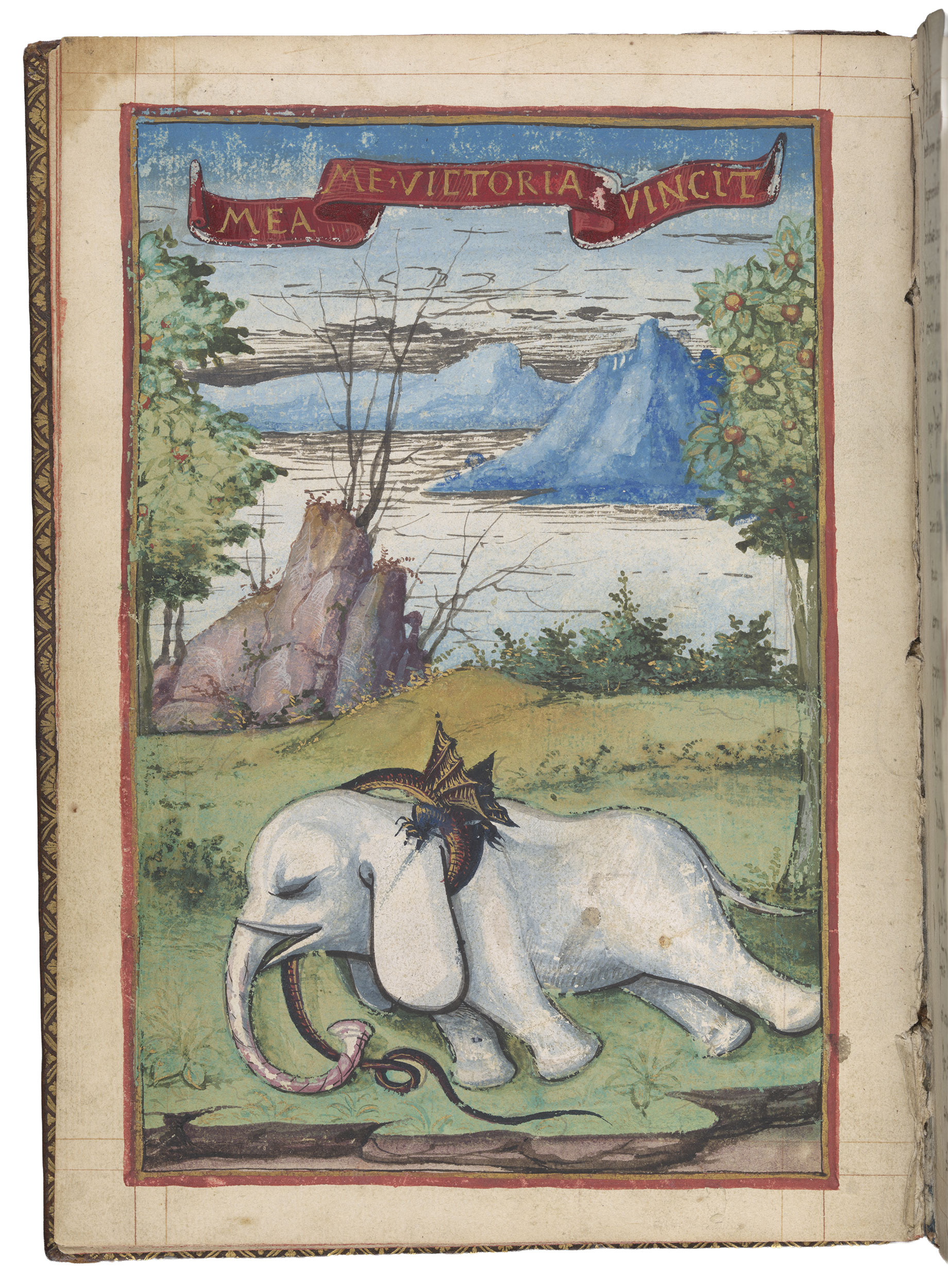
The subjects of the miniatures and their mottos are: fol. 3v: White elephant killed by a serpent, motto 'Mea me victoria vincit'; fol. 6v: One old brown palm tree and two younger green ones, motto 'Mors quoque vita nova est'; fol. 7v: Two trees, one bearing fruit the other flowering, on either side of a rock, motto 'Sine fructu plurima florent, et sine flore ferunt fructum multa'; fol. 9v: Two men, one on the ground, his broken sword at his side; the other holding him by the arm while slitting his wrist with a dagger, motto 'Vulnus opemque fero solus'; fol. 11v: An adult ape in a tree, two young ones having fallen to the ground, motto 'Sic pignora chara parentum indiscretus amor perdit prodestque neglectis'; fol. 13v: Two men fighting with swords and shields, motto 'Prodit plerumque gerentem scutum'; fol. 16v: Two men in armor, one holding the other; a white horse has its hooves on the one's shoulder and is biting the man, motto 'Iustus dolor iraque quos non reddit acres'; fol. 19v: Young man striking an older man with a meat cleaver; two other men at a table are eating severed body parts, motto 'Pietas crudelis amorque impius est multis'; fol. 22v: Two jousting horsemen, one fallen, his horse reaching for a crested helmet, motto 'Et iam sua gloria honosque bruta capit'; fol. 26v: A group of dark-haired older men and a group of white-haired younger men, motto 'Non coma sola facit nigra vel alba sene'; fol. 29v: Two men at a smithy: one hammering a piece of iron on an anvil, the other stoking the fire with bellows, motto 'Sic ferro ignique probatur que vera est virtus'; fol. 31v: Man playing bagpipes before a tomb, motto 'Blanda dulcedine cantus torpentes animos ciet'; fol. 33v: A panther eating a dead animal while other animals watch, motto 'Sunt noxia plurima que vis delectent pascantque oculos'; fol. 35v: A hunter blowing a horn, with two dogs, motto 'Invidus ipse inviso ut noceat nocet et sibi'; fol. 37v: A white elephant, its eyes bleeding, with a serpent coiled at its feet; a dragon giving birth to another dragon in the background, motto 'Superas astutia vires'; fol. 39v: Blindfolded semi-nude Venus sowing seed, motto 'Sic enecat orta ut nova producat Venus'; fol. 41v: Three ships at sea before a city, motto 'In pelago terreque urbesque recedunt'; fol. 43v: An ostrich eating a horse-shoe, a donkey eating flowers, and a bird eating a frog, motto 'Non idem dulce cuique dulcia sunt aliis alia'; fol. 45v: A man and a laden camel on the back of another camel, motto 'Et bruta iniusta recusant pondera et excutiunt'
Artist: Nicolas Duprat or Dupré.
The prefatory dedication is 'Ant. a Burgo Franciae cancellario N. a Prato', that is: to Antoine du Bourg, Lord Chancellor of France (from 1535 until his death in 1538), from N. Du Pré/Dupré/Duprat. The latter may be a relative of du Bourg's predecessor, Cardinal Antoine Duprat (he had an illegitimate son called Nicolas), or possibly the Nicolas Dupré who was a printer and bookseller in Paris in the early 16th century.
This is plausibly the only record of this text, as there are no known printed versions. Each of the nineteen miniatures has a caption in the image, followed by a description of between two and five pages explaining the meaning of the emblem.
50 leaves (the last 3 blank), 20-22 lines in brown ink, ruled in red; collation: i + 53 + i leaves
Original foliation in ink 1-20 omitting leaf after fol.12, later foliation in pencil 21-51 correcting earlier omitted leaf, occasional remains of earlier foliation in lower left margin of rectos.
Nineteen miniatures, each headed by a motto in liquid gold on a red scroll.
The motto on fol. 44v is a pasted replacement.
The subjects of the miniatures and their mottos are: fol. 3v: White elephant killed by a serpent, motto 'Mea me victoria vincit'; fol. 6v: One old brown palm tree and two younger green ones, motto 'Mors quoque vita nova est'; fol. 7v: Two trees, one bearing fruit the other flowering, on either side of a rock, motto 'Sine fructu plurima florent, et sine flore ferunt fructum multa'; fol. 9v: Two men, one on the ground, his broken sword at his side; the other holding him by the arm while slitting his wrist with a dagger, motto 'Vulnus opemque fero solus'; fol. 11v: An adult ape in a tree, two young ones having fallen to the ground, motto 'Sic pignora chara parentum indiscretus amor perdit prodestque neglectis'; fol. 13v: Two men fighting with swords and shields, motto 'Prodit plerumque gerentem scutum'; fol. 16v: Two men in armor, one holding the other; a white horse has its hooves on the one's shoulder and is biting the man, motto 'Iustus dolor iraque quos non reddit acres'; fol. 19v: Young man striking an older man with a meat cleaver; two other men at a table are eating severed body parts, motto 'Pietas crudelis amorque impius est multis'; fol. 22v: Two jousting horsemen, one fallen, his horse reaching for a crested helmet, motto 'Et iam sua gloria honosque bruta capit'; fol. 26v: A group of dark-haired older men and a group of white-haired younger men, motto 'Non coma sola facit nigra vel alba sene'; fol. 29v: Two men at a smithy: one hammering a piece of iron on an anvil, the other stoking the fire with bellows, motto 'Sic ferro ignique probatur que vera est virtus'; fol. 31v: Man playing bagpipes before a tomb, motto 'Blanda dulcedine cantus torpentes animos ciet'; fol. 33v: A panther eating a dead animal while other animals watch, motto 'Sunt noxia plurima que vis delectent pascantque oculos'; fol. 35v: A hunter blowing a horn, with two dogs, motto 'Invidus ipse inviso ut noceat nocet et sibi'; fol. 37v: A white elephant, its eyes bleeding, with a serpent coiled at its feet; a dragon giving birth to another dragon in the background, motto 'Superas astutia vires'; fol. 39v: Blindfolded semi-nude Venus sowing seed, motto 'Sic enecat orta ut nova producat Venus'; fol. 41v: Three ships at sea before a city, motto 'In pelago terreque urbesque recedunt'; fol. 43v: An ostrich eating a horse-shoe, a donkey eating flowers, and a bird eating a frog, motto 'Non idem dulce cuique dulcia sunt aliis alia'; fol. 45v: A man and a laden camel on the back of another camel, motto 'Et bruta iniusta recusant pondera et excutiunt'
Artist: Nicolas Duprat or Dupré.
The prefatory dedication is 'Ant. a Burgo Franciae cancellario N. a Prato', that is: to Antoine du Bourg, Lord Chancellor of France (from 1535 until his death in 1538), from N. Du Pré/Dupré/Duprat. The latter may be a relative of du Bourg's predecessor, Cardinal Antoine Duprat (he had an illegitimate son called Nicolas), or possibly the Nicolas Dupré who was a printer and bookseller in Paris in the early 16th century.
This is plausibly the only record of this text, as there are no known printed versions. Each of the nineteen miniatures has a caption in the image, followed by a description of between two and five pages explaining the meaning of the emblem.
Script
Cursive
Language
Latin
Century
Catalog link
Classification
Department